• Home
  • Collaborators and Clients
  • Schoolyards For Thought
  • Recess Project
  • Contact
  • More
    • Home
    • Collaborators and Clients
    • Schoolyards For Thought
    • Recess Project
    • Contact
  • Sign In
  • Create Account

  • My Account
  • Signed in as:

  • filler@godaddy.com


  • My Account
  • Sign out

Signed in as:

filler@godaddy.com

  • Home
  • Collaborators and Clients
  • Schoolyards For Thought
  • Recess Project
  • Contact

Account


  • My Account
  • Sign out


  • Sign In
  • My Account

Recess

Two kids walking by a blue brick wall, one wearing a beanie and pink top.

Recess as an Everyday Environment

Recess is one of the most consistent and widely shared experiences within the school day.


If schoolyards are the space, recess is the time when that space is most actively experienced. 


It is when students navigate the environment in real time—figuring out where to go, who to be with, what they can do, and how to participate.


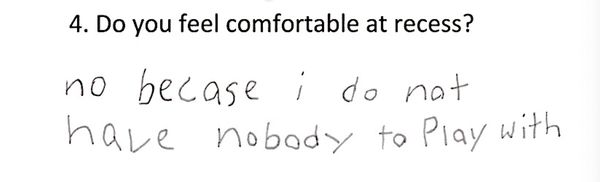
During recess, students move through a series of small, continuous decisions and interactions. They negotiate access to space and activities, respond to social dynamics, and make sense of expectations that are often implicit rather than explicitly taught.


Recess is often understood as a break from learning. In practice, it is a setting where many of the social and developmental experiences that shape students’ relationship with school unfold.


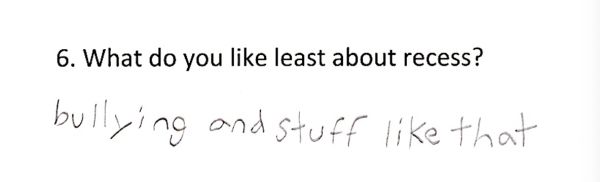
Those moments of connection, exclusion, uncertainty, and engagement are not isolated—they are experienced repeatedly and accumulate over time - and this is so critical to chidren's developmental well-being.


What happens during recess carries into classrooms, influencing how students feel, relate to peers, and participate in learning.

Beyond Time: The Conditions of Recess

Discussions of recess often focus on:

  • How much time is provided
  • Whether it is protected or withheld


While important, these are only part of the picture.


Recess is shaped by the same conditions that define schoolyards more broadly:

  • How space is organized
  • How students are supported and supervised
  • What norms and expectations are in place
  • How access to activities and equipment is structured


Without attention to these conditions, recess can become:

  • A site of exclusion or uncertainty
  • A source of conflict
  • Or a missed opportunity for connection

Recess as a Lever for Well-Being and Engagement

When conditions are intentionally designed, recess becomes:

  • A space where belonging and social connection are strengthened
  • An opportunity for diverse forms of play, rest, and participation
  • A setting that supports emotional regulation and well-being
  • A bridge between social experience and classroom engagement


In this way, recess is not separate from learning—it is part of the everyday environment that shapes it.

A Systems Level Perspective

Recess reflects broader decisions about:

  • School policies and routines
  • Supervision structures
  • Access to space and resources
  • Cultural expectations about play and behavior


Improving recess therefore requires more than protecting time. It requires aligning:

  • Design
  • Social practices
  • Organizational structures

Connecting Recess and Schoolyards

Recess is where the schoolyard is most actively experienced.


Understanding and improving recess is central to understanding how schoolyards function—and how they can better support students’ development, well-being, and engagement over time.

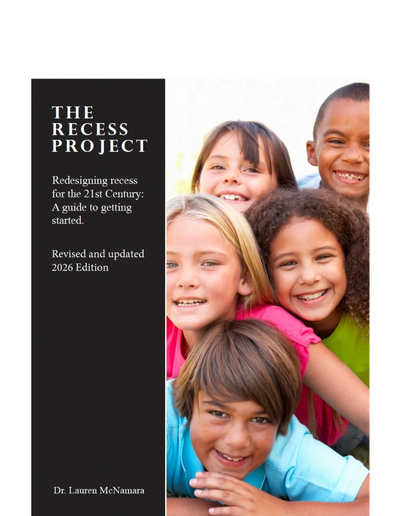
The Recess Project Change Guide

Endorsed by Physical and Health Education Canada and reviewed by members from the Canadian Paediatric Society, the Canadian Human Rights Commission, Canadian Public Health Association, Department of Paediatrics at UBC, UNICEF Canada, People For Education, and the Canadian Association of School System Administrators, this guide is the product of a unique research collaboration of school boards, administrators, staff, policymakers, and (most importantly) elementary school students. It is a collection of evidence-based lessons learned and was designed from a systems-change to ensure sustainability.


  • Overview: Mental Health, Well-Being, and Recess 
  • Developmental Need for Free, Unstructured Play
  • Supporting Children's Fundamental Social and Emotional Needs
  • Role of the Recess Committee 
  • Role of the Recess Coordinator
  • Supervision VS Support
  • Guidelines for involving students in the change process
  • Training materials for Student Leaders
  • Printable Templates, Sign up Sheets, Scripts, Posters 
  • UNCRC – the Right to Play 
  • Planning for inclement weather
  • As Safe As Possible to As Safe As Necessary: Risk Management
  • Games Library
  • Guidelines for managing equipment and materials

Access the Changemaker's Guide Here

Download PDF

See a Selection of our Resources on Recess

National Position Statement on Recess (CAN)Policy - what to includeRecess Planning Checklist for Schools

Copyright © 2026 Dr. Lauren McNamara - All Rights Reserved.

Powered by

This website uses cookies.

We use cookies to analyze website traffic and optimize your website experience. By accepting our use of cookies, your data will be aggregated with all other user data.

DeclineAccept